|
|
|
Reading Age
Children hear and understand stories long befor they can read, thus Hearing Age and Reading Age are two different things.
The most important learning to read period for any child is 2 through to 7 years old, a key part of this is developing verbal skills through hearing spoken language from birth (crucial brain pathway development occurs during the period 0 to 7 years).
Every child is different, there is no such thing as One Size Fits All. The key is to find stories children enjoy. The sooner children start to enjoy stories the sooner they will develop reading skills and the desire to read for themselves.
Start children on short simple stories and move onto longer more complex stories as soon as they are able to sufficiently understand and enjoy them.
New words and phrases are learned through hearing them for the first time and learning their meaning from a Parent or Teacher.
There is a lot of conflicting information about reading age from countless sources, it is better not to take specific reading ages too seriously. Suitable stories may fall over two bands, for example, 4 to 6 years to cover Hearing and Reading Age ability.
The general methods used to find reading age measure the point at which ability stops, thus a story said to be suitable for a particular reading age would be difficult in parts for some around that reading age.
When encouraging reading for enjoyment, it may be better to try and ensure the story content does not present too much of a challenge, to avoid a negative experience in the early stages.
Once the desire to read has started to develop, more challenges can be introduced.
There is a wide range of Links and Resources at the bottom of this page.
Our Age Banding
Our stories are age banded but we do not often show this information simply because we are encouraging reading for enjoyment, not age banded reading skills.
We currently use the following spread reading age bands which reflect the ages at which the stories are likely to be enjoyed, your child's actual Hearing and Reading Age could be different.
2-5 years
3-7 years
5-8 years
6-10 years
7-12 years
9-14 years
Test Your Children's Reading Age
If you want to simply and easily test your children's reading age then you could use the Revised Burt Test (put forward by Channel 4), although dated (1974), it is based on sound common sense and over 2000 children's real reading ability.
To download the Burt Test (cached)
Click Here
Download C4's Test Guide (cached)
Click Here
The Historic Reading Age Mess
Some reading material assessment schemes assume children under 5 do not read and then magically at 5 years suddenly have a reading ability, other different schemes confusingly conflict, assessing the same reading material suitable for reading ages of both 5 and 14, no help to parents or teachers.
Many book shops, especially national chains, neatly band books into strict age bands, but the overlooked reality is children themselves have a wide reading age spread which can be over several years.
Progressive Authors and Publishers understand these problems and attempt to spread reading age advice such as "up to 7", however the major players in the book distribution industry still insist (2009) upon rigid story age banding, thus many good stories are never found simply because they are classified in the wrong place.
Part of the problem is the book classification industry (eg: Nielsen who registers books and issues ISBN numbers) which insists on a rigid age range of 0 to 5, then 5 to 7 etc. Such age bandings do not help non experts (most parents) who, as a result, may not select the most suitable story book for their children.
Parents (and Teachers) naturally want to feel their children are progressing so it does not help if the most suitable story for a child 6 to 7 years old is classified 5 years or less, children themselves all want to be grown up, many do not want to read books labelled for under 5's.
Chris Brown, former primary head teacher and Review Editor for 'The School Librarian', tells us all: "As a head teacher I'd have deplored receiving books for children's pleasure-reading age-banded - I'd need to deface them with black permanent pen-blobs over the offending bit of the cover - and in selecting books on a limited budget on the whole I'd have avoided those known to be age-banded."
Many publishers and authors do not say which reading age measuring scheme they use, so even if parents and teachers had the substantial time to study and understand all the reading age assessment schemes, they would still be in the dark unless they tested each individual book themselves.
The simple solution is to apply common sense, that is, know your child and spread the reading age, for example, a story suitable for a 5 year old might also be suitable for children between 3 and 7 years old.
Problems with Low Reading Standards
Reading standards in some developed countries are unnecessarily low, some reports put it like this: "one third of children leaving school can not read properly."
"Children who develop poor verbal skills during the first three years of development will tend to do poorly in language and literacy in the school system, and children who develop poor verbal skills in the first two years are at risk for antisocial behaviour as teenagers." (JF Mustard MD, The Canadian Institute for Advanced Research)
Read Dr Mustard's article
Click Here
or cached
Click Here
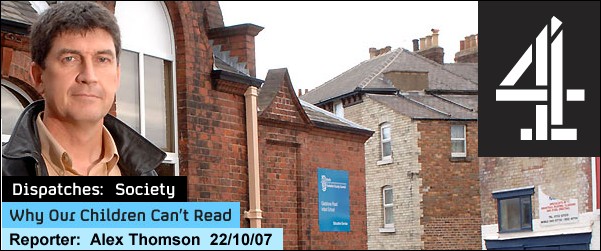
Channel 4's Dispatches has done some great work to highlight some of the UK's education problems.
"According to Government statistics [2007], a fifth of youngsters leaving primary school can't read and write properly. That means they have not reached the benchmark reading age of an 11-year-old and are unlikely to be able to follow lessons when they go to secondary school." (Alex Thomson - Channel 4 Dispatches: Why Our Children Can't Read 22 Oct 2007)
"Those children who had not achieved a reading age of over nine were unable to access the curriculum - and dealt with the problem by disrupting lessons or, in extreme cases, simply refusing to enter the classroom. Following reading tests the school took radical steps, including ripping up lesson plans. As the head teacher says: What's the point of learning French [or anything else] if you can't read English?" (Channel 4 Dispatches: Why Our Children Can't Read 22 Oct 2007)
Read the article
Click Here
or cached
Click Here
Links and Resources
The information below is in no particular order, please note we do not necessarily endorse the content.
If you know of any other helpful links we could add here or find a broken link please let us know.

The National Reading Campaign
Click Here

The Reading Agency
Click Here

Teachers Net
Click Here

Reading Age Formulae
Click Here
or cached
Click Here
TimeTabler - Reading age of material
Click Here
or cached
Click Here
BBC How Television is Damaging Children
Click Here
Visit Dr Aric Sigman's website
Click Here
No to Age Banding campaign
Click Here
Dyslexia Help
Click Here
Springboard For Children
Click Here
Volunteer Reading Help
Click Here
Real Action
Click Here
|
